But Why Bother? In Defense of Nobody’s Heroes

There is a lot to value about artistic recognition, but this is a cheer for the value of being solidly nobody.

There is a lot to value about artistic recognition, but this is a cheer for the value of being solidly nobody. Considering the Zen idea of “beginner’s mind, best mind” helps to highlight how the point is to keep beginning. The people I find most interesting (both well-recognized and completely unknown) are those who are more interested in what is confusing or new to them than anything they have already done. Life rarely fits any limited ideas of what it should look like, and this is the deep appeal of the misfit creative beings who go on doing their thing, pursuing deep interests and questions: not because anyone is asking, but because there is some life there, and sometimes because no one else is looking for or after it. 

To share from the point of strangeness and isolation, a person may create openings in the walls of strangeness and isolation that prevent us from knowing each other. It is interesting and deeply human, and a deeply loving act of service: the project of creating homes and supportive ecosystems that work with and for ourselves and the lives around us, regardless of who is or isn’t asking, noticing, picking up, or recognizing. 

Frank McCourt was sixty-six when he published Angela’s Ashes. He had spent a career as a teacher. Alma Woodsey Thomas had her first show at the age of seventy-five, after a thirty-five-year career teaching art in DC public schools. Mary Delany was seventy-two when she invented her own art form, mixed media collage. 

I am currently reading Helen DeWitt’s brilliant novel, The Last Samurai, which she published at the age of forty-three. This may seem relatively young, until you realize how early and earnestly she began. We live in a culture that loves to celebrate the young phenom, the wild breakout success, but I take heart in knowing that DeWitt’s brilliant “debut” was her 50th manuscript.  In each of the preceding forty-nine, she had labored diligently and faithfully toward her art, in hopes that it would be read and recognized. She was right, but she may have been “proven wrong” if she stopped after the first forty-nine “failures.” I doubt these were artistic failures, now that I have read DeWitt’s work, but her singular brilliance and truly groundbreaking aesthetic no doubt made unfamiliar demands on her readers, so it was likely passed over, in favor of more easily accessible and familiar styles.

These heroes are the passionate, sensitive artists who managed to maintain artistic vision and practice while working in other roles. Recognizing and celebrating the life-giving courage of their radical acts can be a healthy antidote to the common tendency to see perceived limitations as impediments to artistic development. I could do my work if only –– fill in the blanks, depending on the mood and obstacles of the moment. But if the goal is protection and preservation of life, then obstacles and moods, while deeply relevant to our being in the world, have no relevance (generally, in professional life) on whether the work gets done or not.

“Pygmy Tarsiers” by Rodney Campbell on flickr under a Creative Commons Attribution Non-Commercial No-Derivs 2.0 Generic License. *

I am consistently honored, thrilled, and humbled by the power of artists who demonstrate this level of artistic professionalism even as they play working roles as plumbers and dishwashers, house cleaners and repair people; chefs and diaper changers and all-around creative inspirations for managing the way the flow of the substance of any given day can feel like trying to take a sip through a fire hose while trying not to perish from drowning or thirst. 

It’s like that. Not sometimes, not exceptionally; but most of the time, and consistently. I’d rather learn to work with these conditions than cross my fingers and hope for better ones someday. 

*The pygmy tarsier, a nocturnal primate native to Indonesia, was widely believed to have gone extinct in the early 20th century, but then it was accidentally captured (and sadly killed) in a rat trap in the year 2000. Fortunately, since then, several other members of the species have made appearances, and their movements are now being tracked and monitored with great hope, interest, and appreciation for their fragility. One of my favorite species of internet research is searching up newly discovered and rediscovered species. 

When the Muse is On Vacation and they Send in This Guy

So I am now getting down to it.  Ready.  Here I go. Wait –– okay, now.
What are you doing?

Writing. 
Why?

Well, that’s how you do it. 
What are you writing?

I don’t know yet.
So why are you opening a notebook?

It’s called showing up.
For what?

I’ll know when it happens.
What’s happening now?

We’ll see.
It doesn’t look like much. Is that a grocery list?

That’s for later. This is for now.
That also looks like a grocery list.

I make lists. 
Of?

Ideas. Verbs. Names of plants. Names of mythological figures. 
For?

For when it happens.
Oh, aren’t we grand? The happening: Live, ladies and gentlemen, right here! 

Look, I’m trying to do a thing here. Can you. . . go somewhere else?
You put in the order. Now I’m here.

Not for you, though. I can’t think.
What are you thinking?

I don’t know yet.
Hey did you see those images by that guy in the UK who does all the hilarious taxidermy memes? Look, look! You should check this out.

I really––– Oh, that is funny. 
Told you.

Okay, now back to work.
KK, let’s go. What are we doing? Wait, is THAT what you’re doing?

It’s not done yet. It’s just a list.
That looks pretty lame; are you sure you wanna go with that? How long have you been doing this?

Listen, can you just––
Do we have any snacks?

Big and Little: a Reunion

You announced, Play a game, and you returned me––back to what I’d learned how to renounce. 

BIG
I held you in my arms and breathed against the silence. Then, when you were speaking, you announced, Play a game, and you returned me––back to what I’d learned how to renounce. 

When you were speaking you announced, Tell me a riddle! and I held you high above me toward the stars. Here is how to croon what I am learning to announce, of wonder: here is Venus, now Orion; there a satellite, now Mars.

And everything we shared came out in singsong, and every note within it came out true. Teach me spaghetti by the moonlight, drink a spring song. Everything contained a season; it was you, in this loving cup, now brimming, lands the chorus of a soul; long bent on new receiving, long past dying in its hole. Would you wait and listen for the riddle I would tell, beyond the point of speaking past this silence of this well?

Where I have fallen will you find me, if I give you certain clues; will you listen if I play now, every verse of these late blues?

I’m finding now a riddle, and I’d sing it if I could; but I’m out of rhymes, so share here: once, man living, cut for wood.

What’s tall when young, short when old, and can die in a single breath?

This is the end of the time when we rhyme.  But wait!  Consider these words. Another puzzle goes like this. I kept it for you: Consider a fork in the road. 

A stranger in a strange land arrives at an intersection: East or West? One will take you to your destination, the other to hopeless despair. At the fork, two men. Each knows the way, but one always lies. What to do?


LITTLE
Remember how we used to play the guessing game?

Animal, vegetable, mineral: over time, like this: whenever the seahorse, during the age of the narwhal, from time to time, the tortoise––sooner or later, a ferret.

From time to time, a gem squash as long as an English cucumber. In the meantime, this heirloom tomato, and all of a sudden- Rutabaga!

At this instant, taste the snap-peas, until zucchini, okra, chives, until adamantine and agate, since granite, garnet, jacobsite.

Before, until now. Ever after, return. Again!

BIG
Back to the crossroads question, and the two men. Remember this: ask either, “What direction would the other say?”  Whatever you hear, do the opposite, and you will be on the right path.

Whatever you hear, take my hand, in this silence, where I’ve fallen, show me:  Laugh!


LITTLE
[laughing]

Again!

“Baby elephant” by Georg Sander on flickr under a Creative Commons Attribution Non-Commercial 2.0 Generic license. 

Curious Sends Memo to Dead Artist of Living Work

You pessimistic-fantastical visionary of hopes and fears! Jerome of the forest, you left no letters or diaries: what now?

TO:           Hieronymous Bosch

FROM:           Curious 

CC:           Anyone else who might be wondering

DATE:           Now

SUBJECT:         That Garden You Painted

        also:  The way your work is frequently invoked 

                        as an experiential reference point. 

                        As in, This year is feeling very Hieronymous Bosch.  

                        Your name as an adjective–– as with Kafka, or Dali.

                  How one might want to inquire as to your thoughts.

Hieronymus Bosch, The Garden of Earthly Delights, oil on oak panels, 205.5 cm × 384.9 cm (81 in × 152 in), Museo del Prado, Madrid

You: pessimistic-fantastical visionary of hopes and fears,
Jerome of the forest, you left no letters or diaries: what now?

We look on, knowing nothing, about what you “probably meant.” And yet:
You likely lived six decades or more in the house your grandfather built.

You watched, at thirteen, the burning fire of four-thousand homes in your town. You didn’t always favor Flemish style; the transparent glaze concealed.

You wanted revelation, went impasto; rough, to point to your hand.
As if to reject the presumption that it was God painting the forms.

You even signed some; most were lost. The God of your garden was youthful.
How big the fruit! What a menagerie, waiting to explode back home.

It welcomes a memory, of taking great care with a painting of marker on white.
I filled the page with detail; this was first grade, we were asked to draw the garden
I could not wait to be seen, for I knew. What a marvel. I could not wait,
            to share in its delight!
Butterflies cocooned in my center of knowing; I would explode out, soon.

I filled the page with detail in first grade; we drew the garden.
Nobody asked me for a unicorn; I knew it was perfect like I knew drawing breath
Butterflies cocooned in the center, like promises, I would reveal myself soon. 
Teacher made the rounds and paused at my desk; I drew in breath, feeling her moved.

Nobody asked me for a unicorn. There were none in the garden, she told me.
Those are pagan, she said. This was confusion. I thought garden was everything good, and unicorns the best of all time.

She was moved to remind me that everything I ever wanted was exactly the reason for the fall. I was a mute, infant Eve, holding my half-eaten fruit. It soured quickly. I did not draw for her again.

Dear Jerome, your work here raises questions about ambiguity.
Others see total alignment with orthodoxies of your time. Still,
isn’t it ironic, at least somewhat, how much heaven in your hell?

Heavens from earth, the third day, enter this paradise lost. Come in, now!
Rabbits dance behind Eve, suggestive of mating; cautionary tale?
Or just good loving? And what about the dragon tree: eternal life?

Here giraffe, here elephant, here a lion eating prey. Pray, what’s that?!
The cat has the lizard! And who is that cloaked figure reading, right there?
Is that a duck, behind a fish? Without shame? Only curious now.

Hey teens, don’t eat cherries with great lords; they’ll throw the pits in your face. Truth! Women carry fruit on heads; acrobats ride camels and unicorns.
Ladies strut with peacock pluck. Dance, dance, dance! Who waits for their entrance, here?

See winged fish, strawberry! Come inside this shell, land on constant youth!
No child or aged person in sight; they fly in tandem on eagle lions. 

They fly trees of life. See bird of death perched on branches. The gallant knight
wears a dolphin tail, scratching the back of his head; as above, so below.

Then comes damnation, or does it? The dark and cold are over the top, 
Waters frozen, fire waits: a bestiary for feasting on bodies.

City’s burning, river’s blood; crucified on instruments, the choir sings. 
Rotting trunks for tree-man’s arms, his body a broken shell; his gut pierced.

Beasts have at it; wolves eat the last knight; the dragon has run out again.
But Jerome, does it get annoying; everyone speculating about what you

meant; does it get old, everyone asking about the rules of the game,
and all the fine print, forgetting that the point was to play?

Remembering, Borges, Flights

The trick was to remember the state of dreaming. Then I had to flap really hard.

Morning.
Morning!

The dreams are gone again. Memory is full of holes.
Mind the gap!

Do you know whose memory is the least contaminated?
A baby’s?

Maybe, but not what I was thinking. 
?

A patient with amnesia.
?

They can’t contaminate by remembering. It just comes.
And goes.

Right, a free flow. 
Did you hear about the artist with face blindness?

To lose one face is enough. Imagine losing them all.
She made interesting self-portraits. She did them in the dark, feeling her face, adding paint to canvas; feeling again. Art as an act of looking, free of the presumption of sight.

Do goldfish really have only eight seconds of it?
Memory?

Yes, or is this just a myth told to children who would otherwise be very sad about the creature in the bowl, in the plastic bag from the fair, doomed to this constant back and forth?
Borges called it a pile of broken mirrors. 

The fishbowl?
Memory.

He died on this day, in 1986.
That was the year I forgot how to fly in my dreams.

How?
The trick was to remember the state of dreaming. Then I had to flap really hard. My arms, because that’s all I had, no wings or feathers.

Yeah, but how did you forget?
Whoever knows, but that year my dreams or something started taking me too hard and fast, I could not remember until it was too late. 

Borges said there are no images at the end, only words.
Remember 1986?

There were bombs everywhere in the news. I didn’t see them up close, but I worried.
They were waiting under parked cars, in office buildings, churches, synagogues, planes.

It was my first Communion year. I remember waiting to be suffused in light. 
The Challenger exploded. I remember the plumes of flame and smoke on the screen. My second-grade teacher had wheeled the television into the classroom so we could see it live, the techno-miracle of space travel.

Chernobyl, too.
After that, radioactive deposits were found in every country in the northern hemisphere.

There was a human chain that year, five million links long from New York to Long Beach. 
As a reminder, right?

Yes, of hunger. Homelessness. Easily forgotten by the housed and fed.
They were flooding the streets.

This was Reagan’s America. It was popular to cite an epidemic of laziness, compounded by drugs, as the reason. 
Just say No, but the hands did something else.

Said yes?
No, they answered another question. A better one. The question of the body before you. 

Answer like an open hand.
Right. Like, “Here.”

Do you remember Borges’ Book of Imaginary Beings?
He observed that there are dragons in every part of the world.

Yeah, he said we don’t know what they mean, only that they are always there.
What memories do they hold; what future projections? 

I love his face, Borges. How it would light up when he smiled.
He must have been something in person.

Like a baby. Or a person who has forgotten everything and sees only––
Light?

The play of light and shadow.
An uninterrupted flow.

I love watching babies before their vision develops.
Their faces, do you mean?

Yeah, how they light up and start laughing at something in the ceiling.
And you watch them, and you wonder what are they seeing?

And why can’t I?
We probably used to.

But I can’t remember.


“Dragon” by Aqva on flickr under an Attribution-Non-Commercial 2.0 Generic license.


*The idea of a patient with amnesia as having the least contaminated memory comes from Sarah Manguso’s Ongoingness: The End of a Diary, as described beautifully in Maria Popova’s Brainpickings article: “Ongoingness: Sarah Manguso on Time, Memory, Beginnings and Endings, and the True Measure of Aliveness.” 


* A story about artist known as Carlotta appears in the BBC News, and the documentary about her journey, “Lost in Face” appeared in a BBC News article by Vibeke Venema, “Prosopagnosia: The Artist in Search of Her Face,” published August 16, 2020. BBC World Service.

Forms

Considering various mediums, and the interfaces between seen and unseen.

Every medium has its own personality. Paper is delicate so everything gets a dreamy fluid quality, light dissolving over the landscape. On paper you can see the smudge of erasure, the changes, the trial and error. Consider the difference between this and something like film, or film-less photos, those bodies of pixellated light in captivity.

With photographs everything looks like something that a crazed nostalgic is trying to freeze outside of time. Oil on canvas: longings laid bare, to hold what will not be held. The time spent anyway, squinting. 

A bedside book in childhood: Lives of the Saints, dog-eared at Joan of Arc, because of the way she didn’t flinch, that insistently, cross-dressing soul. I think her gift was less that she heard a voice all day long telling her what to do, but that she listened.

Now it’s art books, too heavy to lift with one hand, propped open across a chest and half-waking dreams of Blake’s Jacob’s Ladder, all the near-transparent souls climbing doggedly into blinding light, none looking as though they have any idea what it may be, but there it is waiting, anyway, pouring over and through their bodies and their steps in a luminous column and you get the sense that they’re climbing forever like a white-knuckled novena, World Without End.

Joan was burned at the stake for three reasons: one, she wore pants; two, she wore them into battle; three, what she said about the voice she heard, even after it was clear what would happen if she didn’t retract. There was a line between what you could see and may not see. She crossed.

Before he painted Jacob’s Ladder, William Blake was getting regularly arrested for bar fights, and after he painted his opus, he died, as the legend goes, amid visions of angels. What did he see in them, I wonder, and how was it different from the eternities he saw in hours, the heavens in his wildflowers, or the worlds he found in grains of sand?

A want to hold it all in an instant, the forever dream against countless suggestions that seeing something is almost always very different than seeing everything, and the end of the world something different than the end of every known part. 

“Jacob’s Ladder” by José María Pérez Nuñez on flickr under a Creative Commons Attribution Non-Commercial 2.0 Generic License.

Lost and Found

What if we walked around like we do in these ads, wearing our missing on our chests, like billboards for our losses?

Eastern box turtle in Prince George’s County, Md. by Chesapeake Bay Program on flickr under a Creative Commons Attribution Non-Commercial Generic License

Once I lost my iPhone my wallet, my keys. This on multiple occasions, several each.
Once I found a box turtle! It was in the middle of the street, by the water tower.

Then I lost my wedding ring, my bike, my surfboard.
But listen! Hear this: single mom needs help, getting a car for cheap. Nothing fancy! Please let me know! Thank you.

Missing animal pet? Lost cats, Siamese and tabby, both fixed, please return, no questions asked, I beg you.
I’d lost you anyway, listening to vintage sad songs, seventy to be exact.

Lost parakeet near Sea World, but he could be anywhere. He is friendly, but shy. Lost briefcase, too.
What if we walked around like we do in these ads, wearing our missing on our chests, like billboards for our losses?

Lost childhood friends. I disappeared for a decade, lost all contacts. Do you remember the playground on Euclid with the green monkey bars, near the school? 
I kept your scent on me as long as I could make it last.

You would know when you met me, that I am also missing childhood friends and lost cats, at at least a dozen sets of keys, not to mention those years when who knows what we were thinking, live and learn, not to mention that season when someone left the cage door open overnight and self-respect got out, and I can’t remember why; not to mention, have you seen these memories? Not to mention, have you ever wondered if they really happened? 

Not to mention the way that–––
–––that thing that
–––I meant to tell you
–––was more real than anything I have ever witnessed
–––and there I go, losing the words again.

I lost that one paper I was supposed to deal with. I thought I put it in the special pile with the other Very Important Documents, but it’s not there, and all that is in the pile are a bunch of receipts for things I don’t even own anymore.
And where did the time go? 

Don’t even start.
Have you seen my mojo?

Girl, it’s right there, check it out. Now turn!
[Turn, turn, sashay, turn]

I see you! That’s it, right there. There you are!


* This is why I love craigslist, for the poetry of “Lost and Found” and “Missed Connections
.” Others in this series:

Blurred Visions

Self; not self. You learn to stop wondering about which is which like you learn to accept how it is customary to call the thing you have: one life. How strange, the way that this phrase is stressed, as if it’s a limit.

There’s a moment, and it goes so quickly that it’s easy to miss, when you think you know who you are. The reason, looking back, was that you were not thinking about it at all. You simply were there, doing what you did in the manner that you did things. For example, drinking from a garden hose in your underwear, or writing a five-act musical for Rocky, the elementary school janitor, on the occasion of his retirement. Or showing up on the blacktop before the bell rang for the start of a third-grade day, after any break longer than two weeks, wearing an accent you had acquired on some imaginary voyage to a distant land. Here a brogue, now a drawl, now something approximating the outback. 

“blur” by lee on flickr under a Creative Commons Attribution No-Derivs 2.0 Generic License

Around the age of blood, this changes, and it is no longer considered sufficient to simply make things up as you go; one must have acquired something distant, something not already possessed. You’re not sure what it is, but you understand that the time has come to go out looking and stop pretending that you know what you need. The point, it seems, is to listen. Others know exactly what you need, especially men, who have no shortage of ideas as to what you ought to do. It will be decades before you learn to categorize such professions of wise-seeming advice into the file of “Men explain things to me” (Thank you Rebecca Solnit, Sheila Heti). 

But it’s not just that. It’s in the way you look, like you’re practically begging the world to explain something to you. 

Sometimes you stop, staring, and think, “Here is something.” You think this because you are wondering and because whatever you are looking at is indeed something. It’s enough anyway, to remind you back in the direction of something that you almost thought you knew. But it isn’t that, not exactly. 

The nuns had a saying for missing things. “St Anthony, St. Anthony, come around,” they chanted, over the lost items. It gave the frantic seekers something to do while they looked.

Self; not self. You learn to stop wondering about which is which like you learn to accept how it is customary to call the thing you have: one life. How strange, the way that this phrase is stressed, as if it’s a limit.

One lives.

For the Birds

“i hope i die
warmed
by the life that i tried
to live”
 –Nikki Giovanni

Image: Regent Honeyeater by Michelle Bartsch on flickr under a Creative Commons Attribution Non-Commercial No-Derivs 2.0 License

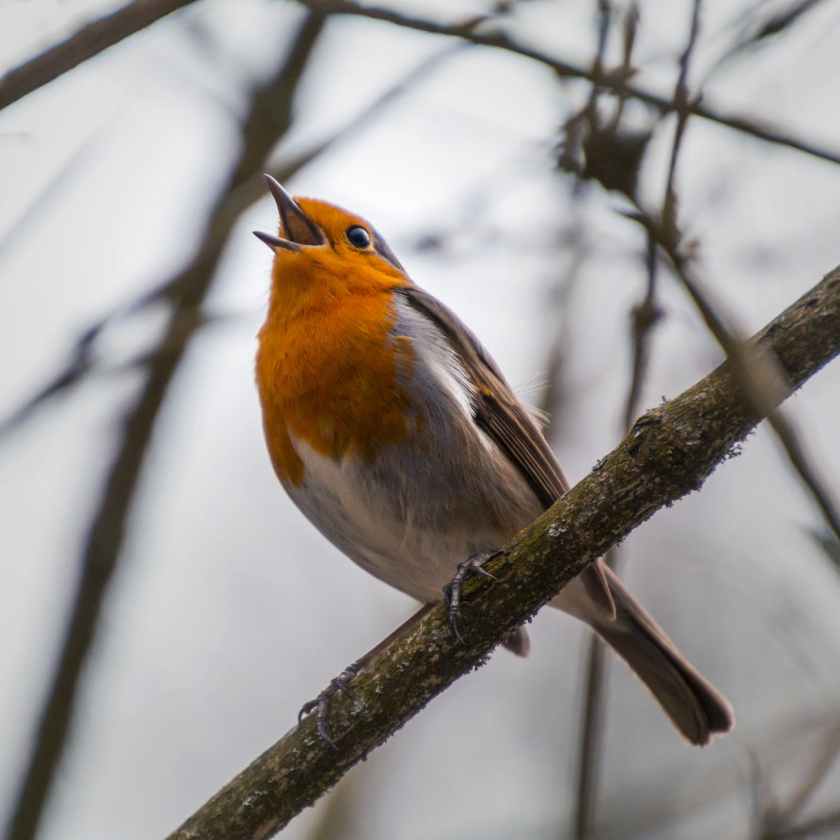
The regent honeyeaters of Australia have been dealing with a serious problem. It started in the usual way––with their massive disappearances, caused by habitat destruction; but this is a different problem, one left to those remaining. Apparently, there aren’t enough mature birds around to teach the young males to sing. The new guys are doing their best, imitating the songs of other birds and sometimes improvising here and there, but the females of the species are listening for some very specific notes. If she doesn’t hear them, mating season can’t go on as usual. The problem is raising alarms among ornithologists worldwide. One solution is to bring some birds in on a sort of contract basis, like visiting professors. Early trials of this method are promising.
 
Humans have a hard time resisting the impulse toward anthropomorphism, zoomorphism, and most other inclinations toward turning a given fact about the natural world around something applicable to human behavior. As one, I can’t help thinking about all the time we’ve ever wasted teaching anyone anything except with the impulse toward song at the center. Doing or not doing this becomes a matter of species survival. Maintaining protected spaces for development and nourishing of song becomes a matter of fundamental security. Maintaining an ecosystem in order to ensure that an emerging song, when it finally surfaces, will not be drowned in a constant din of noise, becomes a matter of painstaking vigilance, as with the protection of any species of newborn life, anywhere.

Live at the Apocalypse!

Let’s go! someone said, meaning to the apocalypse. I thought it was coming to us.

Photo by Pixabay on Pexels.com

Let’s go! someone said, meaning to the apocalypse.
I thought it was coming to us.

Sure, but let’s meet it.
What do we bring?

Whatever you want. Everything! But you may have to check it at the door.
Will there be snacks?

No, just a single unrestricted feast.
Dress code?

The less, the better.
What else?

Bring every ending, every lilting note of your unuttered cry––
What about the pets?

Well, obviously the dog comes with.
And the cat?

You know cats. I suggested this morning and she just gave me a look.
Like, “Again with this apocalypse?”

I think she’s probably done a few already.
What about the sleeping arrangements?

Have you been listening? Who’s sleeping?
Will there be singing?

At first, only silence, and then, there will only be singing.

Exit mobile version
%%footer%%