Up and Out, Slowly

Opening notes.

After any weekend, Monday’s alarm tends to come with no small amount of reluctance. When it sounds, my first thought is about finding a corner to hide in with my blanket and pillow. My second is more sleep, with vague calculations in the fuzzy background about how long I can get away with this before the snoozed alarm sounds again. 

For this reason, this day tends to demand a lot of coaching on my part. I have asked Buzz (cat) for a little help, but she’s in the opposite corner now, facing the wall and likely engaged in astral projection. I’m not on her level yet, so the best I can do for now is make coffee, then a list.

I hope to create something with this day, and to let what may be created live in me. Also, to redeem some of my bad habits, such as wanting to hide under a blanket indefinitely. I hope to keep my eyes open well enough to find moments of joy and share it. I mean to help where I can, and I am going to need some help doing this. To comfort and be comforted. To listen and hear. Not for answers, but music. I don’t know how any of this is supposed to work. May I find music spacious enough to fold me into its rhythm. 

Shepherd

The real work of preserving life.

Protect her but know this. Only by doing so in earnest can humility be learned. Some are inclined to believe that the charge begins and ends with what the lost believe is the sole triumph of her sex, forgetting that it is not her womb but how she sat with the creatures in the yard, soothed the sick and the dying, welcomed and fed strangers, and traveled long distances to meet the ones in prison. Some would claim to defend life while they abandon her to her grief, and to all the rest of her work.

Not all of her children are living, but they all have names, and it would be a mistake for anyone outside the limits of her skin to presume to know them––or her, the contents of her heart or the will of her womb. 

There are reasons why the Liberator––who so many seem to prefer in infant form––preferred, as a man, the laying on of hands. There are reasons why he knew to send her attackers away, forgoing either law or personal insult, saying only this: let he who is clean of living cast the first stone. Another time, he asked Simon, in the company of another supposed criminal, Do you see this woman? Weeping and extravagant in her devotion, others would dismiss her on legal grounds, citing purity codes. He knew her by her tears. Later, when he met the women on the road of sorrows he said to them, Weep not for me, but for yourselves, because the day will come. 

To ignore the grief of this moment is to fall asleep again in the garden, when all that was asked was vigilance over one who is persecuted and afraid.

Becoming Shelter

Remaining human in wartime.

At first, it was the usual set of former pets in wartime––cats and dogs. She stayed with them as the shelling continued. The ground was shaking, she says, of her arrival. The dogs were tearing holes in the fence with their teeth.

Later, it became clear that there was no one else to watch the turtles, the peacocks––and who would feed the lion? They left a land mine near his cage. She tried bribes. They detonated. The lion lived. They locked her in a room, killed her dog.  She buried Jina under a tree. When they locked her in a room, they told her she would die if she tried to leave. She left the room. It was time to feed the animals. It is always time, she says. Always.

It haunts her, to imagine the noises the horses made, neighing in the burning stables she could not reach. The shelling continues, and she continues here. It doesn’t matter who you protect, she says. You rescue what you can to remain human when war would make you forget.

***

On the work of Asya Serpinska, a seventy-seven-year-old Ukranian woman sheltering over 700 animals in Hostomel, roughly twenty miles northwest of Kyiv.

Encounter in the Desert

The hermit to the artist.

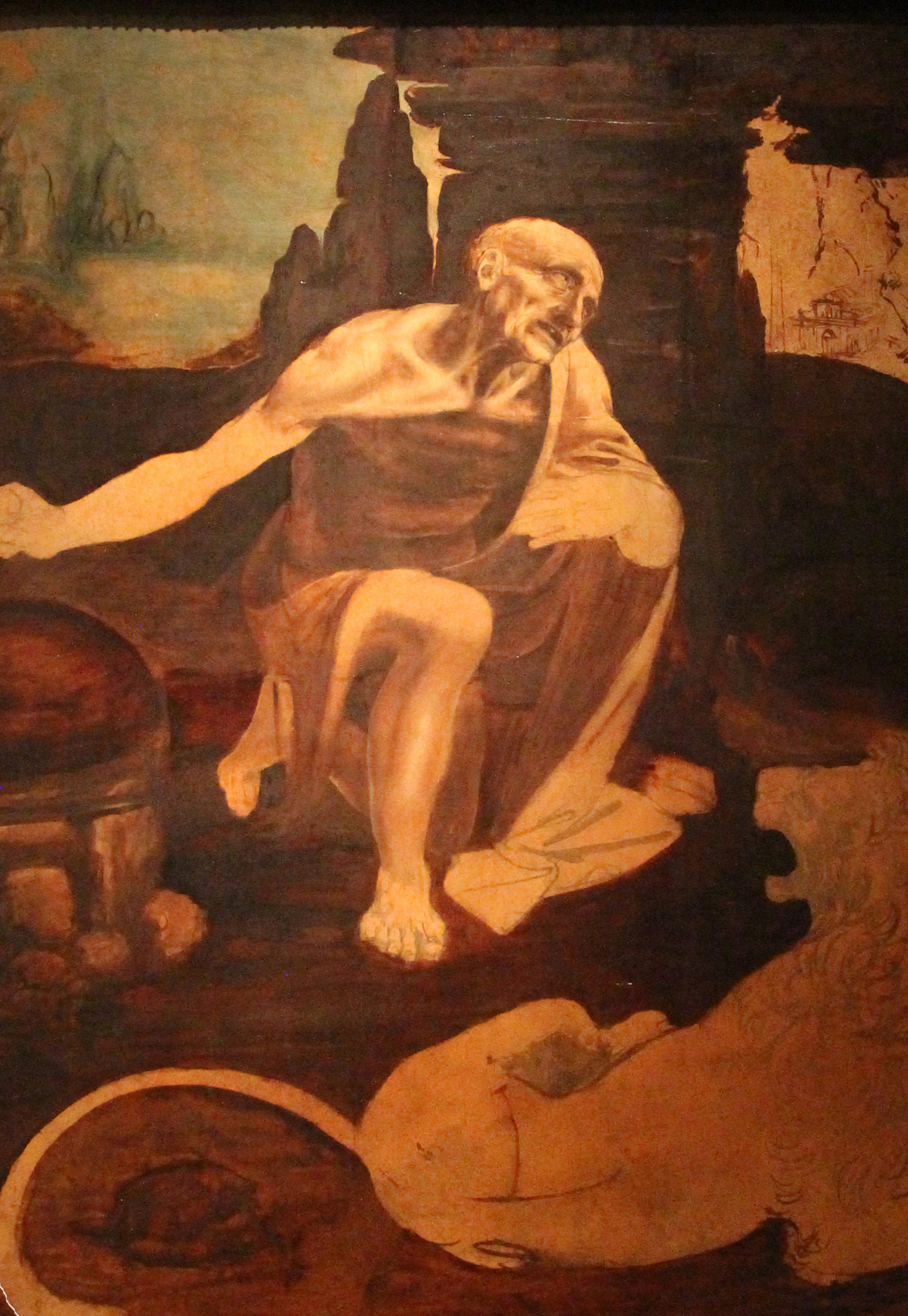
You thought you were learning to live, kid? Sure, if you want. Live it up. But look around. See these rocks? And beyond? What’s next? I tell you, it isn’t another commission and you’ll be going empty-handed. Think I always dressed like this? I had clothes, finery. But what for, here? I get it, though. Look at me, even now. One hand clutching the rock, I can’t help myself, but look out there. Name one solid form. 

Leonardo Da Vinci’s Jerome in the Wilderness

I can’t either. Are you on the lion now? Sure, but put your hand here. Feel: fur, warmth, body. Breathing, just like us. Dying, too. Not soon, I hope. I named him Leo, actually, but don’t let it go to your head. He’s not a symbol of courage or danger, just a fellow creature I met along the way. He was suffering, too. You’ve probably heard the stories. Sure, I pulled a thorn from his paw, but it wasn’t what they make it out to be. Poor guy was almost passed out from the pain when I got to him. It was infected, he had lizards in his mane. Now we’re friends and he waits with me here. We walk together when we’re not on these rocks. Sure, you can come.

Why are you here, anyway? Let me guess. You think if you can study the extent of my torment, you can be ready for it. Let me tell you, night after night the dancing girls would come visit as I slept, to mock my restraint.  They still come, but I’ve lost most of my vanity by this point, so the torture is less. 

So now what? It’s a long walk back. Where’s your horse?

***

In honor of the birthday of Leonardo DaVinci (1452-1519), today’s post is in an imagined voice of one of his subjects. DaVinci worked on St. Jerome in the Wilderness toward the end of his life, and the painting (which hangs in the Vatican) was never finished. DaVinci appears to have been in a difficult time in his life, in part related to a sexual scandal, and also because his worldview was shifting with age. “I thought I was learning to live,” the painter wrote in his diary around this time, adding, “I was only learning to die” (from Liana Bortolon’s The Life and Times of Leonardo). In this light, I can only imagine that St. Jerome’s hermetic life in the desert may have been of special interest. An apocryphal story about Jerome features him pulling a thorn from the paw of a lion.

Almost Endless

For a Monday morning.

We all fall from our infinities. These landings have a way of knocking the wind from the lungs. After the crash, there’s a stillness before it begins again. Inhale, exhale.

Loquat, cypress, tire swing. Field mouse, damselfly, dark-eyed junco. Brush rabbit, baby, coyote. All of this before you even find your feet again.

What will you do without your delusions of endlessness? The unbound forever vanished, here is a beginning instead.

Breaking Silence

A tribute.

When silence is betrayal, when uncertainty mesmerizes, a calling to speak can be a vocation of agony––so rejoice as well, because we are here in firm dissent, a new spirit among us.

No document from human hands can make any of the persecuted less our brothers––sisters, hear their broken cries. They watched us poison water, bulldoze land, and the children run in packs in the street, seeking food for their mothers.

Family, village, land––destroyed. The initiative is ours now, to somehow cease this madness, to be prepared, with every creative protest possible. To challenge the young with alternatives, each by their own convictions.

There is a deeper malady here, and the answer so readily dismissed as weak is love––courageous, relentless against fear.

Let us hope. We still have a choice.

Begin. 

***

Exactly one year before he was assassinated, Dr. Martin Luther King, Jr. delivered his speech “Beyond Vietnam––Time to Break the Silence” at Riverside Church in New York City. Today’s post is a tribute to this moment, assembled from words and phrases in this speech. Found poetry is one of my favorite ways to listen.

Crossings

Keeping watch in the dark.

Hundreds gather beneath the remains of a bridge they meant to cross. They wait, watching the river, for the next chance to move. One, looking back, says the children are scaredthey are killing them over there. When a cloud of dust settles, some are still unmoving in the road, a dog beside them barking, and even David is shrouded in black now, to mark the deaths.

At the border, a woman waits for her cousin, traveling for days with children. The men are back home fighting, but where is home now? 

We are trying to get them out, she says, to save their lives, at least. Do you see me, cousin? She jumps and waves. A child runs to her, hooded in a pink parka. There is weeping all around and weary smiles of relief. It is calmer now, she says, and they move from the wire fence of the thin border between the known world and the next.

***

Details culled from New York Times coverage of events on the eleventh day of the Russian invasion of Ukraine. With love and prayers for all who flee war and persecution.

Hope in the Dark

Against other constants, and at random.

“Everything I ever thought to be a nightmare is nothing compared to what I am witnessing.”

Voice of Diana Berg, Mariupol Resident, in “No Water, No Electricity: Life Under Siege in Mariupol”

I wanted to tell you, when we spoke last week, about the child returned to the swing before the bombed-out building where he once lived, lifting his foot to the sky anyway, before he can know the word for resistance; and also about the the women gathered close in a kitchen, by the thin window before it broke, passing cake around on patterned plates with good silverware, saying to one another Here, here. Eat––

but the conversation followed another line, and then time was up, and now the shelling is constant and at random and I don’t think the child is swinging anymore, and I don’t know what happened to the women with the cake, if they got on a train the next day, or went underground, and I don’t want to end with this––

constant

––did you hear about the babies born in the basement of the Metro station? Yes, there were several and you could hear the mothers’ screams below against the shelling above, but it is said they are okay now, these babies not because they are at home––and where will that be–– the shelling constant

and at random

––when this is done, 

when is this done? It is constant

but they are at their mother’s breasts and there is still milk even as the mothers are weeping, especially as the mothers are weeping, there is weeping constantly now and at random, and there are also the tiny fingers wrapped tight around a mother’s pointer finger, as if to hold her pointing in place

this

finger like a compass needle dotted with this row of little nails. Strong grip, people say, for some excuse to laugh, and everyone agrees, because this is here now, the grip of the newborn whose first days begin and end here, whose home is mother.

***

Inspired by the documentary mentioned above, featured in the New York Times, March 5, 2022 (Created by Masha Froliak, Ainara Tiefenthäler, Dmitri Khavin, and Sarah Kerr), in which Diana Berg also observes, “The shelling is constant and at random.” Also by stories like this, of births in the metro station. The title of this piece nods to Rebecca Solnit’s brilliant work, especially her Hope in The Dark: Untold Histories, Wild Possibilities.  

Exodus

It’s an old story.

There’s a chronicle, now familiar, which begins with the names of the dead, to announce how the land was filled with them before their children ripened and became more and mightier than those that had meant to harvest them year after year for profit.

The king got wise, orchestrated erasure of the boys first. But the midwives saved them and among these was one from the tarred basket in the river who once saw his brother badly beaten by a guard and was moved to kill and bury the body. Back into hiding, he was found again by a woman at the water, and because he helped her, she bore him a son, and when the king died it was time to cash a check in the name of the children.

So went the keeper of Jethro’s flock, to the mountain to witness a burning light. Take off your shoes, said a voice. Here is holy ground.

The voice continued: I’ve heard them, know their sorrows. Now you go, release them. The man asked for a name, saying they will want to know who sent me, but all that came was this reminder, I am.

He got the elders, and they took a lamb to the desert, and nothing was known at all but this command to go forth, and begin the work of ––don’t say freedom, because if salt loses its flavor what is the point? Say instead, not having to hide the babies in the river. Say instead, not having to hide the bread, or trade bodies for bread for hidden babies in the river.

Again, the voice: Take the serpent by the tail. Show them a sign with your hands. If they won’t see it, offer another. Teach your mouth, too, and leave me to the ears. 

***

With prayers for the safety and protection of all who flee persecution and war.

Notes Before Dawn

Against the void.

So much depends on finding some beginning, a way in––the next breath, the first word, the next right thing, the first step into it. The despair before the task is so looming, a body could easily be swallowed in its shadow. And will be, unless. There is the next breath, the next right thing, the next step, the first word. Say it.